
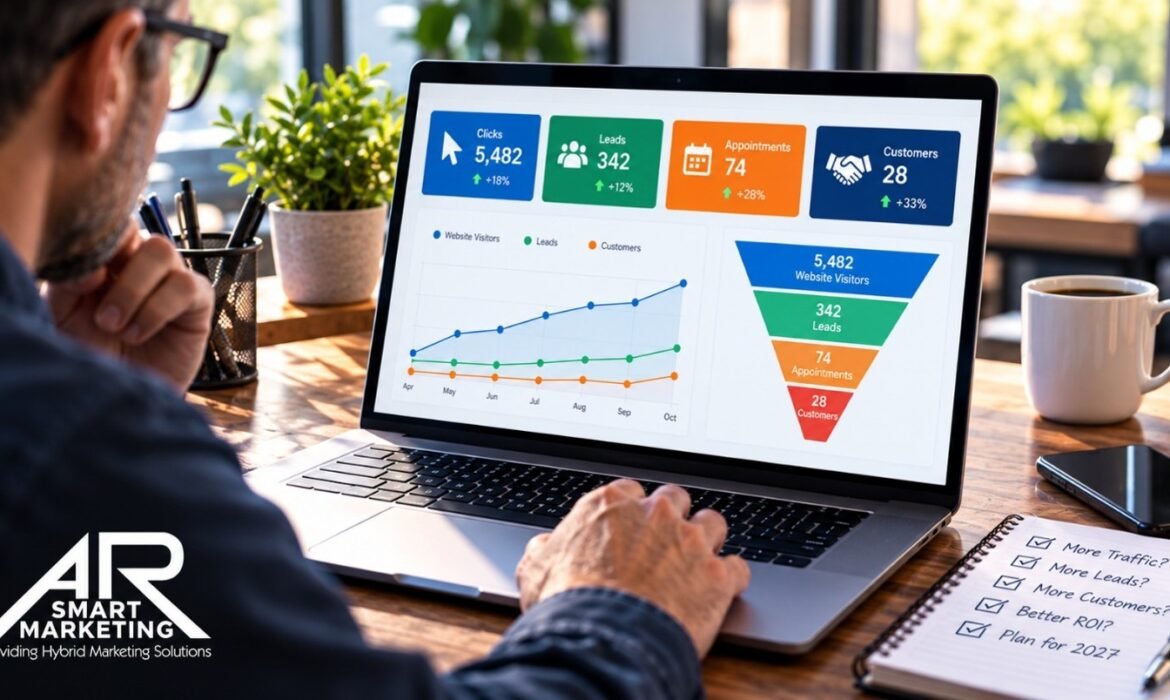
You’re Getting Clicks, But Are You Getting Customers?
Your latest marketing report looks impressive.
Website traffic is up. Your Google Ads campaign generated hundreds of clicks. Your social media posts are reaching more people. Maybe your display advertising is delivering thousands of impressions.
On paper, everything looks like it’s moving in the right direction.
But there’s one question that matters more than all those numbers:
Is your marketing actually bringing in customers?
For small and midsize businesses in Waterloo, Cedar Falls, and throughout Iowa, this is where marketing can become confusing. Business owners are presented with reports filled with clicks, impressions, engagement rates, and website sessions, but those numbers don’t always explain whether their investment is producing meaningful results.
The problem isn’t that these metrics are useless. They’re important indicators of how your marketing is performing.
The problem comes when we confuse marketing activity with business growth.
Quick Answer: Why Aren’t Marketing Clicks Turning Into Customers?
Marketing clicks don’t always become customers because attracting attention is only one part of the buying process. Visitors may leave because the website doesn’t answer their questions, the offer isn’t relevant, the next step isn’t clear, or the business doesn’t follow up quickly enough. Measuring qualified leads, conversion rates, customer acquisition costs, and actual sales alongside clicks helps businesses understand whether their marketing is producing meaningful results.
Clicks Tell You Someone Was Interested. They Don’t Tell You What Happened Next.
Let’s say a local home improvement company runs a Google Ads campaign and generates 1,000 clicks in a month.
That’s encouraging. It suggests the advertising is attracting attention.
But what if only ten people request an estimate?
And what if only two of those requests turn into paying customers?
Suddenly, the conversation changes.
The company didn’t necessarily run a bad advertising campaign. It may have attracted the wrong audience, sent visitors to an ineffective landing page, or failed to convert qualified prospects.
The important question becomes: Where did the opportunity break down?
This is why understanding the difference between marketing clicks and conversions matters.
A click is an action someone takes to visit your website or landing page.
A conversion is a meaningful action you’ve defined, such as submitting a qualified inquiry, requesting an estimate, scheduling an appointment, making a purchase, or calling your business.
Google’s documentation on Google Analytics key events explains how businesses can identify and measure important customer interactions.
But even a conversion doesn’t automatically mean you’ve gained a customer.
A completed contact form may be a lead. A scheduled appointment may be an opportunity. A completed sale is an actual business result.
Understanding those differences gives business owners a much clearer picture of their marketing.
The Metrics That Matter Depend on Your Business Goals
Not every business measures success the same way.
A local retailer may care about online purchases, store visits, and repeat customers.
A remodeling contractor may measure qualified estimate requests and signed projects.
A dental practice may focus on new patient appointments.
A professional service provider may track consultations that eventually become paying clients.
The right marketing metrics depend on what you’re trying to accomplish.
Website traffic and advertising impressions help explain visibility. Click-through rates can indicate whether an advertisement is attracting attention. Engagement can reveal whether people are interacting with your content.
But qualified leads, appointments, sales, customer acquisition costs, and revenue help explain business outcomes.
For example, consider two hypothetical advertising campaigns.
Campaign A generates 800 clicks and 12 inquiries.
Campaign B generates 350 clicks and 25 inquiries.
If both campaigns attract similarly qualified prospects, Campaign B may be delivering more value despite generating less traffic.
Of course, the real comparison also depends on advertising costs, lead quality, and how many inquiries become customers.
That’s why we shouldn’t judge marketing performance using a single number.
Your Website May Be Where Good Marketing Goes to Waste
Sometimes the advertising is doing exactly what it’s supposed to do.
It’s reaching the right people and encouraging them to visit your website.
But once they arrive, the experience creates obstacles.
Perhaps the page loads slowly. Maybe the services aren’t explained clearly. The contact form might be unnecessarily complicated, or visitors can’t immediately determine whether the business serves their area.
A potential customer may be genuinely interested but still leave without taking action.
Google’s Core Web Vitals documentation explains how loading performance, responsiveness, and visual stability contribute to the experience people have on a website.
Technical performance matters, but so does clear communication.
A homeowner in Cedar Falls looking for an electrician shouldn’t have to search through several pages to find out whether the company handles panel upgrades.
Someone in Waterloo looking for a roofing contractor should quickly understand how to request an inspection.
In our September article, Your Competitor Isn’t Always Better—They May Just Be Easier to Buy From, we explored how unnecessary obstacles can cause customers to choose another business.
That same principle applies here.
More traffic won’t automatically fix a website that makes it difficult for customers to take the next step.
Not Every Lead Is a Good Lead
One of the most overlooked aspects of marketing performance is lead quality.
A campaign might generate dozens of inquiries, but if most come from people outside your service area, prospects looking for services you don’t offer, or customers who aren’t a good fit, those leads may have little business value.
That’s why local businesses need to look beyond the number of forms submitted or calls received.
A qualified lead is someone whose needs reasonably match the products or services your business provides and who has a realistic opportunity to become a customer.
For a contractor, that might mean an inquiry from a homeowner within the service area who is planning a project the company actually handles.
For a financial services company, it could mean someone seeking a product or service the institution offers and meeting the relevant eligibility criteria.
For a business-to-business company, it may involve a prospect with the right type of organization, project requirements, and purchasing authority.
The objective isn’t simply to generate the most leads.
It’s to generate opportunities that can become profitable customer relationships.
What Happens After Someone Contacts Your Business?
Imagine that your marketing campaign generates 30 qualified inquiries this month.
That’s a promising result.
But what happens next?
Are phone calls answered?
Are voicemail messages returned?
Does someone respond to website inquiries?
Are appointments confirmed?
Does anyone follow up when a prospect requests information but isn’t ready to buy immediately?
This is where marketing performance and business operations become closely connected.
A business could have excellent advertising, a professional website, and strong customer reviews, yet still lose opportunities because inquiries aren’t handled consistently.
Marketing automation, customer relationship management systems, and organized follow-up processes can help businesses respond more consistently and maintain relationships with prospects.
But the technology is only part of the solution.
Someone still needs to understand what happens between the initial inquiry and the completed sale.
If a marketing report shows 40 leads, but nobody knows how many became customers, there’s an important piece of the picture missing.
Understanding the True Cost of Acquiring a Customer
Let’s look at another hypothetical example.
A local business spends $2,000 on advertising during a month.
The campaign generates 500 clicks, 40 inquiries, and eight new customers.
Now suppose the average new customer generates $1,500 in revenue.
Those eight customers would represent $12,000 in revenue.
That’s useful information, but it doesn’t automatically mean the campaign generated $10,000 in profit.
The business still needs to consider the cost of delivering its products or services, labor, overhead, and other expenses. A complete customer acquisition cost calculation may also include agency fees, sales expenses, and other acquisition-related costs.
The important point is that the conversation has moved beyond clicks.
We’re now evaluating what the marketing investment actually contributed to the business.
And that’s a much more meaningful discussion.
Why Measuring Marketing Results Isn’t Always Simple
Today’s customers rarely interact with a business through only one channel.
Someone might see a social media post, encounter a display advertisement, search Google several days later, read online reviews, visit the company’s website, and finally call.
Which marketing channel deserves credit?
That’s the challenge of marketing attribution.
Google’s Analytics attribution documentation explains how attribution models assign credit to different interactions along a customer’s path to a key event.
However, digital tracking doesn’t capture every influence.
A customer may remember a direct-mail piece, hear a streaming audio advertisement, notice a local sponsorship, or receive a recommendation from a friend before searching for the business online.
That’s why AR Smart Marketing believes in looking at the complete customer journey rather than treating each marketing channel as an isolated activity.
Our article How Combining Print and Digital Marketing Drives Better Results for Local Businesses explains how traditional and digital channels can reinforce one another.
A business may not be able to attribute every sale perfectly, but it can still develop a more useful understanding of how its marketing contributes to growth.
Your Existing Customer Data Can Help Complete the Picture
One of the biggest advantages businesses have is information about their actual customers.
Your advertising platform may tell you how many people clicked.
Your website analytics may tell you how many visitors submitted a form.
But your customer database, sales records, or CRM can help show which leads became customers and what those relationships were worth.
In our October article, Your Customer List May Be Your Most Valuable Marketing Asset—Are You Using It?, we explored how first-party customer data can improve segmentation, retention, and future marketing.
That information can also help evaluate marketing performance.
When appropriate tracking and recordkeeping connect the original inquiry with the eventual sale, a business can begin identifying which campaigns generate qualified opportunities and which channels contribute to stronger customer relationships.
The objective isn’t to collect more data simply for the sake of collecting it.
It’s to use accurate, responsibly collected information to make better business decisions.
Before Planning Your 2027 Marketing Budget, Look Beyond the Clicks
As 2026 comes to a close, many local businesses are beginning to evaluate next year’s marketing investments.
This is an opportunity to ask more meaningful questions.
Which campaigns generated qualified leads?
Which channels contributed to new customers?
Where did prospects stop moving forward?
Were inquiries handled consistently?
Did the business generate repeat purchases or referrals?
Were some marketing channels building awareness that supported conversions elsewhere?
The answers may reveal that some campaigns deserve additional investment while others need adjustments.
They may also show that improving website conversion, customer follow-up, or reporting could create more value from the marketing budget already in place.
At AR Smart Marketing, we believe a successful marketing strategy should connect visibility, engagement, lead generation, conversion, and customer relationships.
Because marketing doesn’t end when someone clicks an advertisement.
That’s often where the real opportunity begins.
Frequently Asked Questions About Marketing Clicks and Conversions
What is the difference between a marketing click and a conversion?
A click occurs when someone interacts with an advertisement or link to visit a destination. A conversion is a meaningful action defined by the business, such as submitting a form, making a phone call, scheduling an appointment, or completing a purchase.
Why am I getting website traffic but no leads?
Possible reasons include attracting the wrong audience, unclear website messaging, weak calls to action, poor mobile usability, slow loading times, or an offer that doesn’t match visitor expectations. Reviewing traffic quality and visitor behavior can help identify the problem.
What is a good website conversion rate for a local business?
There is no universal conversion rate that applies to every local business. Results vary by industry, traffic source, offer, audience, and the type of conversion being measured. Businesses should establish their own baseline and work toward improving it.
How do I know whether my marketing is actually working?
Track meaningful outcomes such as qualified leads, appointments, sales, revenue, customer acquisition costs, and repeat business alongside clicks and impressions. Comparing those outcomes with marketing expenses helps reveal whether campaigns are contributing to business goals.
What is the difference between cost per lead and customer acquisition cost?
Cost per lead measures how much a business spends to generate an inquiry or lead. Customer acquisition cost measures the expense associated with gaining a paying customer. The latter may include advertising, sales, agency, and other acquisition-related expenses.
Can a campaign with fewer clicks produce better results?
Yes. A campaign attracting fewer but more qualified visitors can generate more inquiries or customers than a campaign with higher traffic but weaker audience relevance.
Why is marketing attribution important?
Marketing attribution helps businesses understand how different interactions contribute to conversions. Because customers may encounter multiple digital and offline marketing channels before purchasing, attribution provides useful insights even when it cannot capture every influence perfectly.
Should small businesses track actual sales from their marketing?
Whenever practical, yes. Connecting marketing inquiries with sales records or CRM information can help businesses understand lead quality, conversion performance, acquisition costs, and the financial value of their marketing investments.
Make Your Marketing Accountable to Real Business Results
At AR Smart Marketing, we help businesses look beyond impressions, clicks, and surface-level reporting to understand how their marketing contributes to meaningful growth.
Our hybrid approach combines SEO, website development, paid search, programmatic advertising, social media, email marketing, marketing automation, print, and direct mail to create more connected marketing strategies.
For businesses in Waterloo, Cedar Falls, the Cedar Valley, and throughout Iowa, our goal is to help make marketing investments more informed, measurable, and effective.
If you’re seeing activity in your marketing reports but aren’t sure whether it’s turning into customers, it’s time to look at the bigger picture.
Explore AR Smart Marketing’s services or call 319-281-0346 to discuss how we can help connect your marketing activity to real business results.


